

Global Vegetable Seeds Market to Reach USD 14.27 Billion by 2034, Growing at 5.36% CAGR
Vegetable seeds market trends
Key companies covered in the vegetable seeds market include BASF SE, Bayer AG, Takii & Co., Ltd., East-West Seed, and Bejo Zaden B.V., among others.
Asia Pacific Leads Global Vegetable Seeds Market as Industry Expands at 5.36% CAGR Through 2034”
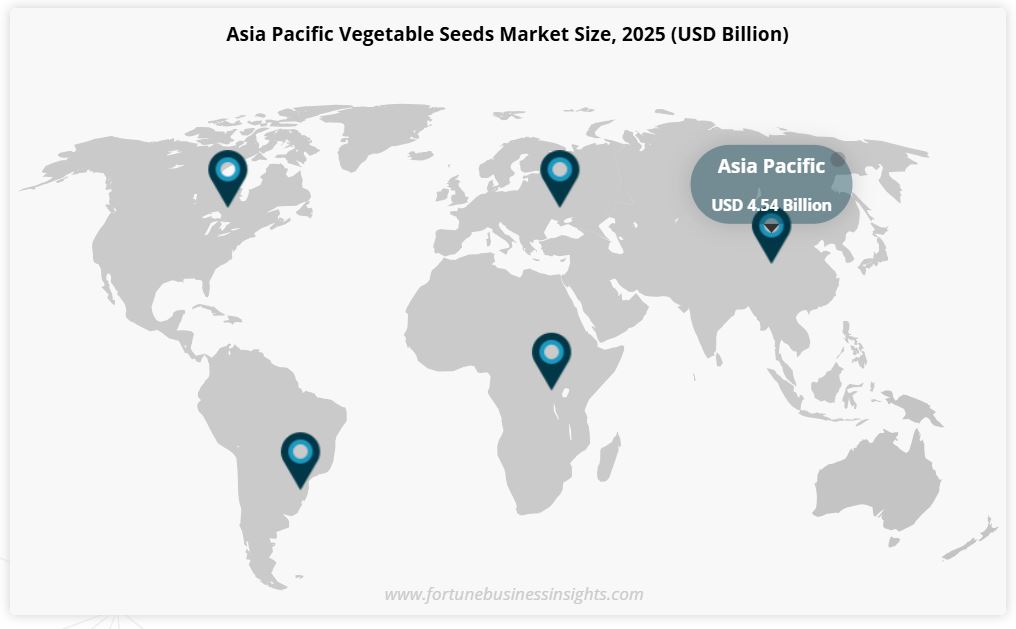
PUNE, INDIA, February 3, 2026 /EINPresswire.com/ -- The global vegetable seeds market is projected to grow from USD 9.40 billion in 2026 to USD 14.27 billion by 2034, registering a CAGR of 5.36% during the forecast period. Asia Pacific dominated the vegetable seeds market with a share of 50.97% in 2025, supported by strong vegetable consumption, expanding horticulture acreage, and rising adoption of quality seeds in major agricultural economies such as China and India. Moreover, the U.S. vegetable seeds market is expected to reach USD 734.95 million by 2032, driven by increasing consumer preference for home-grown and organic vegetables, along with rising awareness regarding food quality and traceability.— Fortune Business Insights
Vegetable seeds are the primary agricultural input used to grow vegetables such as tomatoes, peppers, cucumbers, onions, carrots, cabbage, and leafy greens. These seeds are available as open-pollinated varieties and hybrids and are developed to enhance yield, disease resistance, shelf life, and adaptability to diverse climatic conditions. Rising global demand for nutritious food and dietary diversification continues to strengthen the importance of high-quality vegetable seeds in modern agriculture.
Get a Free Sample Research Report:
https://www.fortunebusinessinsights.com/enquiry/request-sample-pdf/vegetable-seed-market-103066
Key Players
The vegetable seeds market is moderately consolidated, with major players investing in breeding technologies, product innovation, and geographic expansion. Leading companies include Bayer AG, Syngenta AG, Groupe Limagrain, BASF SE, and Rijk Zwaan Zaadteelt en Zaadhandel B.V..
These players focus on launching new varieties, strengthening distribution networks, and adopting advanced breeding tools to meet evolving farmer and consumer requirements.
Market Drivers
Rising Demand for Nutritious and Healthy Diets
Vegetables are rich sources of essential vitamins, minerals, fiber, and antioxidants. Growing awareness about the role of vegetables in preventing chronic diseases such as obesity, cardiovascular disorders, and diabetes has increased their consumption worldwide. This shift toward healthier eating habits is directly increasing the demand for vegetables, thereby fueling the need for quality planting seeds.
Expanding Global Population and Food Security Concerns
Rapid population growth is intensifying pressure on agricultural systems to produce more food from limited arable land. Vegetable seeds with higher yield potential and better resistance to pests and diseases are increasingly preferred by farmers to improve productivity and ensure food security.
Rising Adoption of Hybrid Vegetable Seeds
Hybrid vegetable seeds are engineered to offer superior traits such as uniform growth, higher yield, improved taste, extended shelf life, and resistance to environmental stress. Farmers are increasingly adopting hybrid seeds as they provide consistent performance and higher returns, which is positively influencing market growth.
Market Restraints
Climate Change and Unpredictable Weather Patterns
Changing climatic conditions, including irregular rainfall, droughts, floods, and temperature fluctuations, significantly affect vegetable cultivation. These conditions increase crop vulnerability to pests and diseases and can reduce seed performance, thereby restraining market growth.
High Cost of Hybrid Seeds
Although hybrid seeds offer higher productivity, their relatively high price compared to open-pollinated varieties limits adoption among small-scale and resource-constrained farmers, particularly in developing countries.
Speak To Analyst:
https://www.fortunebusinessinsights.com/enquiry/speak-to-analyst/vegetable-seed-market-103066
Market Segmentation
By Type
The market is segmented into open-pollinated varieties and hybrid seeds.
Open-pollinated varieties are expected to dominate the market, accounting for around 82.45% share in 2026. These seeds are widely used in developing countries due to their lower cost, easy availability, and ability to save seeds for replanting.
Hybrid seeds are anticipated to witness faster growth owing to their superior agronomic traits, including better yield, uniformity, and disease resistance.
By Crop Type
Major crop types include Solanaceae, root & bulb, cucurbit, brassica, leafy, and others.
The Solanaceae segment (tomato, potato, eggplant, and pepper) dominates the market with a 41.17% share in 2026. Tomatoes account for the largest share within this segment due to their high consumption and very high seed replacement rate.
By Cultivation Method
The market is segmented into protected cultivation and open field.
Protected cultivation accounts for a major share, driven by the growing use of greenhouses and controlled-environment agriculture to improve yield, reduce crop losses, and enable year-round production.
Open-field cultivation continues to hold a significant share, particularly in developing regions where greenhouse infrastructure is limited.
Regional Insights
Asia Pacific
Asia Pacific leads the global vegetable seeds market and is expected to maintain dominance throughout the forecast period. China and India are major contributors due to high vegetable production, rising population, and increasing adoption of improved seed varieties. Japan also represents a key market with strong demand for high-quality vegetable seeds.
North America
North America is witnessing steady growth driven by strong demand for organic vegetables, urban gardening, and greenhouse farming. The U.S. remains the largest contributor in the region.
Europe
Europe shows considerable demand due to advancements in breeding technologies and strong emphasis on sustainable agriculture. Countries such as Germany, France, and the Netherlands are key markets.
South America
Brazil dominates the South American vegetable seeds market, supported by high vegetable consumption and strong seed export activity.
Middle East & Africa
The market in this region is driven by rising vegetable cultivation, increasing population, and growing awareness regarding balanced diets. Turkey and South Africa are key contributors.
Key Industry Developments
Syngenta acquired Feltrin Sementes in Brazil to expand its vegetable seed portfolio.
BASF launched a new tearless onion variety in Europe.
Bayer expanded its organically produced vegetable seed offerings.
Sakata Seed Corporation expanded its lettuce seed portfolio through acquisition.
The global vegetable seeds market is poised for steady growth through 2034, supported by rising vegetable consumption, increasing awareness of healthy diets, and growing adoption of high-quality seeds. Technological advancements in breeding, expansion of protected cultivation, and strong demand from Asia Pacific will continue to shape market dynamics. Companies that focus on innovation, affordability, and region-specific crop solutions are likely to gain a competitive advantage in the evolving vegetable seeds industry.
Related Reports:
Hybrid Rice Seeds Market Size, Share, 2024
Hybrid Seeds Market Size, Share And Analysis
Ashwin Arora
Fortune Business Insights™ Pvt. Ltd.
+91 83390 92966
sales@fortunebusinessinsights.com
Visit us on social media:
LinkedIn
X
Legal Disclaimer:
EIN Presswire provides this news content "as is" without warranty of any kind. We do not accept any responsibility or liability for the accuracy, content, images, videos, licenses, completeness, legality, or reliability of the information contained in this article. If you have any complaints or copyright issues related to this article, kindly contact the author above.
