

Molecular Breeding Market to Reach USD 13.27 Billion by 2034 at 14.43% CAGR (2026–2034)
Molecular Breeding Market
Global molecular breeding market valued at USD 4.02 billion in 2025 is projected to reach USD 13.27 billion by 2034, growing at a CAGR of 14.43%.
The molecular breeding market is set to grow from USD 4.02 billion in 2025 to USD 13.27 billion by 2034 at a 14.43% CAGR, driven by demand for high-yield and stress-resistant crops.”
PUNE, MAHARASHTRA, INDIA, February 3, 2026 /EINPresswire.com/ -- The global molecular breeding market size was valued at USD 4.02 billion in 2025. The market is projected to grow from USD 4.52 billion in 2026 to USD 13.27 billion by 2034, exhibiting a CAGR of 14.43% during the forecast period. North America dominated the global market with a share of 36.07% in 2025.— Fortune Business Insights
Get Free Sample PDF Here: https://www.fortunebusinessinsights.com/enquiry/request-sample-pdf/molecular-breeding-market-114575
Market Overview
Molecular breeding is a scientific method used to improve the traits of plants and animals using advanced molecular biology tools. This method enables the identification and selection of desirable traits and their integration into plants and animals with higher accuracy and efficiency. As molecular breeding is faster and more precise than traditional breeding technologies, its adoption is expected to grow significantly in the coming years.
Key players operating in the market include Thermo Fisher Scientific Inc., Illumina, and Bayer AG. These companies are investing in research and development and expanding their in-house capabilities to innovate and differentiate their product offerings.
Molecular Breeding Market Trends
Integration of Artificial Intelligence (AI) and Machine Learning (ML) in Breeding Programs
Artificial intelligence and machine learning tools are increasingly integrated into molecular breeding platforms to generate faster, more accurate genetic insights. Companies such as Corteva Agriscience and Bayer are adopting AI-driven tools to improve sequencing accuracy and accelerate trait development in crops and livestock.
Market Dynamics
Market Drivers
Growing Demand for High-Yield, Stress-Resistant Crops Supports Market Growth
Climate change is one of the major factors impacting crop yields and food availability globally. Increasing droughts, pest infestations, and extreme weather events such as floods and prolonged dry spells are reducing agricultural productivity. Molecular breeding helps develop advanced seeds with improved traits such as drought tolerance, pest resistance, higher yields with limited inputs, and enhanced food security, thereby supporting market growth.
Market Restraints
High Production Cost to Impede Market Growth
Molecular breeding is a research-intensive and costly process. It requires high-quality specialized laboratories and highly trained professionals with deep technical expertise. These high initial investment requirements deter small startups and new entrants, which is expected to restrain market growth over the forecast period.
Market Opportunities
Growing Interest in Emerging Economies Creates Opportunity to Explore Untapped Application Areas
Government funding plays a crucial role in supporting molecular breeding adoption in emerging economies. In India, the Department of Biotechnology funds research programs focused on genomics, transgenics, and gene editing for crop improvement. Similar initiatives are being launched in countries such as Brazil and across Southeast Asia, creating opportunities for innovation, expansion, and increased demand in the market.
Segmentation Analysis
By Breeding Process
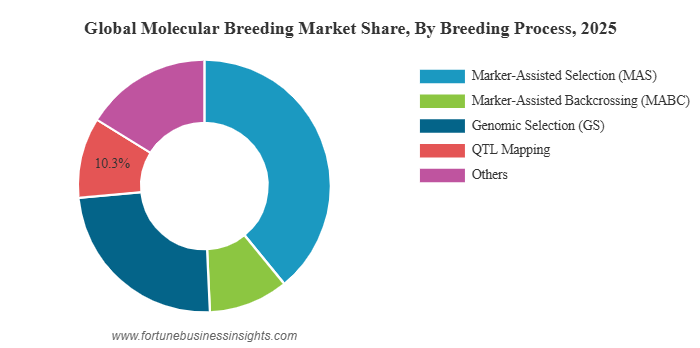
The market is segmented into Marker-Assisted Selection (MAS), Marker-Assisted Backcrossing (MABC), Genomic Selection (GS), QTL mapping, and others.
Marker-Assisted Selection (MAS) accounted for the largest market share due to its low cost, low risk, and ease of integration with traditional breeding methods.
The Genomic Selection (GS) segment is expected to grow at a CAGR of 14.93% during the forecast period due to its ability to analyze complex genetic traits.
By Marker Type
The market is segmented into Single Nucleotide Polymorphism (SNP), Simple Sequence Repeat (SSR), Amplified Fragment Length Polymorphism (AFLP), Restriction Fragment Length Polymorphism (RFLP), Random Amplified Polymorphic DNA (RAPD), and others.
The Single Nucleotide Polymorphism (SNP) segment held the largest market share in 2024 due to its suitability for dense genetic mapping, QTL analysis, and genomic selection.
The Simple Sequence Repeat (SSR) segment is expected to grow at a CAGR of 14.40% during the forecast period due to its accuracy and cost-effectiveness.
By Application
The market is segmented into crop-based and livestock-based applications.
Crop-based applications dominated the market in 2024, driven by the need to improve yield, stress tolerance, and disease resistance to ensure food security.
The livestock-based segment is expected to grow at a CAGR of 13.96% during the forecast period, supported by demand for improved meat, milk, and egg productivity.
By End User
The market is segmented into seed companies, livestock companies, academic & government institutions, and independent breeding service providers.
Seed companies dominated the market in 2024 due to heavy investments in R&D to improve yield, pest resistance, and stress tolerance.
Livestock companies are expected to grow at a CAGR of 14.51% during the forecast period.
Molecular Breeding Market Regional Outlook
North America
North America dominated the market in 2025 and is estimated to reach USD 1.62 billion in 2026. Strong collaboration between public and private research institutions and government initiatives such as USDA ARS, NIFA, and NPGI support regional growth.
Europe
Europe is expected to reach USD 1.39 billion in 2026, driven by advanced R&D infrastructure and widespread adoption of AI and genomic selection technologies. Countries such as Germany, France, and the U.K. are key contributors.
Asia Pacific
Asia Pacific is one of the fastest-growing regions, with the market estimated to reach USD 1.1 billion in 2025. Government investment in food security and adoption of advanced breeding technologies drive growth in countries such as China and Japan.
South America
South America is projected to record strong growth, reaching USD 0.3 billion in 2026, supported by government initiatives to develop disease-resistant and high-yield export crops.
Middle East & Africa
The Middle East & Africa market is witnessing steady growth, with South Africa expected to grow at a CAGR of 13.77% during the forecast period due to increasing investments in food security.
Speak to Analysts: https://www.fortunebusinessinsights.com/enquiry/speak-to-analyst/molecular-breeding-market-114575
Competitive Landscape
Key Industry Players
The molecular breeding market is fragmented, with intense competition among key players focusing on innovation and advanced technology integration.
List of Key Molecular Breeding Companies Profiled:
Illumina, Inc. (U.S.)
Thermo Fisher Scientific, Inc. (U.S.)
Bayer AG (Germany)
Corteva Agriscience (U.S.)
Syngenta AG (Switzerland)
KWS SAAT SE & Co. KGaA (Germany)
LGC Genomics (U.K.)
Zoetis Inc. (U.S.)
Genus PLC (U.K.)
SGS S.A. (Switzerland)
Key Industry Developments
September 2024: Corteva Agriscience launched the Genlytix ecosystem, integrating gene editing, analytics, and partnerships.
May 2024: Zoetis expanded its genomic testing platform for dairy and beef producers.
January 2024: Ohalo Genetics launched the Boosted Breeding platform for high-yield crop development.
Ashwin Arora
Fortune Business Insights™ Pvt. Ltd.
+91 83390 92966
sales@fortunebusinessinsights.com
Legal Disclaimer:
EIN Presswire provides this news content "as is" without warranty of any kind. We do not accept any responsibility or liability for the accuracy, content, images, videos, licenses, completeness, legality, or reliability of the information contained in this article. If you have any complaints or copyright issues related to this article, kindly contact the author above.
